9 Enneagram of Personality | Which Enneagram Type You Are
If you’ve been online recently, you’ve probably seen this word Enneagram floating around. While it might appear to be another trendy personality quiz, experts say it’s much more complex than that. Originally known as the 9 Enneagram of Personality, the Enneagram was first invented in the 1900s as a model of the human psyche. It was used to understand people through nine interconnected personality types.Enneagram personality types are not something you want to be; this is a personality you are born with.
What is 9 Enneagram of Personality ?

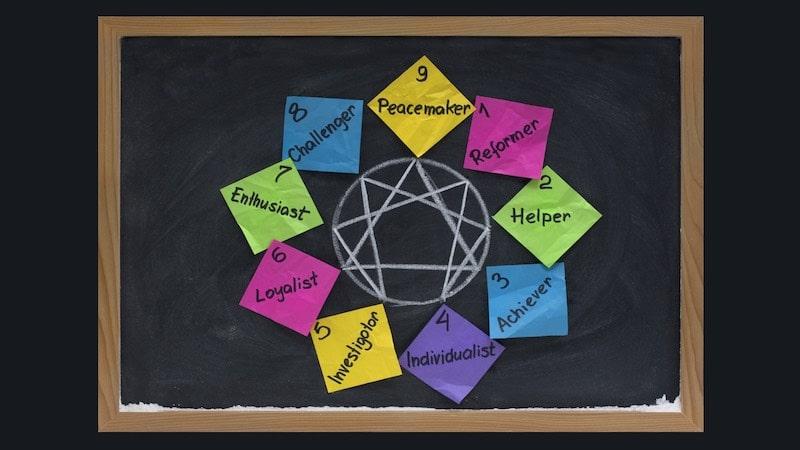
The name Enneagram comes from the Greek: Ennea is the Greek word for “Nine” and Gramma means something that’s “drawn” or written.The Enneagram consists of a nine-point diagram. The outer part is made up of a circle, which then contains a triangle and an irregular hexagon.
The Enneagram is a 3 x 3 arrangement of nine personality types in three Centers. There are three types in the Instinctive Center, three in the Feeling Center, and three in the Thinking Center, as shown below. Everyone experiences all three, but each personality type has a particular strength or “home base” in one of them. This primary center influences our way of being in the world, and is an important key to overcoming blind spots and developing our potential. Balancing the three centers helps us achieve a more balanced life.

Beyond the basic nine personality types, the system grows much more complex and includes 27 different subtypes as well as three key “centers” focused on action, feeling, and thinking. But to keep the article short ( and sweet 🙂 ), we will stick to 9 types here.
9 Enneagram of Personality Types

9 Enneagram of Personality Types
Here is a list of short descriptions of the 9 Enneagram of Personality types.
Type One – The Perfectionist / Reformer
Continuous need to improve themselves. Harsh inner critic. Inspire & encourage others to grow. There’s a right way to do things, mistakes aren’t allowed. Very self-controlled – anger is covered up. To a Type 1, anger is an unsuitable emotion. Lives are very structured & controlled & they may be frequently frustrated & upset with others. Type 1 is part of the Instinctual (Body) Triad of the Enneagram along with Types 8 & 9.
Type Two – The Helper / Giver
People oriented, extremely perceptive about other people’s needs, feelings & what others want. For a 2 to put themselves first is selfish, at least that’s what they believe. To a 2 everyone else’s needs come first. They repress their feelings and needs and rarely ask for help. They do however, expect you to know what they want and need since they anticipate yours and will become resentful if you don’t. Type 2 is part of the Heart Triad along with Types 3 & 4.
Type Three: The Achiever / Performer
Threes want to be successful and admired by other people, and are very conscious of their public image. Type Threes fear failure and not being seen as valuable by other people. They wanna be the best at everything they do. Not necessarily craving power but recognition. They strive through hard times because they are more prone to optimism. These are the people in High School that write 10 pages instead of 5 for a final paper. Type 3 is part of the Heart Triad along with Types 2 & 4.
Type Four: The Individualist / Romantic
Fours want to be unique and to experience deep, authentic emotions. Type Fours fear they are flawed and are overly focused on how they are different from other people. Offers their advice compassionately. They are self-absorbed & focus on what is missing in their lives. Type 4 is part of the Heart Triad along with Types 2 & 3.
Type Five: The Investigator / Observer
Fives seek understanding and knowledge, and are more comfortable with data than other people. The biggest fear of the Type Five is being overwhelmed by their own needs or the needs of other people. . Their main way of looking at life is through their minds. Stimulated by ideas and very analytical. Type 5 is part of the Head Triad along with Types 6 & 7.
Type Six: The Loyalist / Skeptic
Loyal & committed to family & friends. Security seekers. For the Type Six, the greatest fear is being unprepared and unable to defend themselves from danger. They have an eye for catching & anticipating problems & issues. Doubtful, can act fearful and anxious and focus on negative outcomes. Type 6 is part of the Head Triad along with Types 5 & 7.
Type Seven: The Enthusiast / Epicure
Sevens want to have as much fun and adventure as possible and are easily bored. Type Sevens fear experiencing emotional pain, especially sadness, and actively seek to avoid it by staying busy. They are quite capable of handling several things at once. Can get lost in the search for the next bright & shiny object. Takes on too many things, keeps options open. Type 7 is part of the Head Triad along with Types 5 & 6.
Type Eight: The Challenger / Protector
Eights see themselves as strong and powerful and seek to stand up for what they believe in. The greatest fear of the Type Eight is to be powerless, so they focus on controlling their environment. Protects & helps others who are weaker than them. Harden themselves & hide vulnerabilities so as not to be perceived as weak. Direct & blunt. Type 8 is part of the Instinctual (Body) Triad along with Types 1 & 9.
Type Nine: The Peacemaker / Mediator
Nines like to go with the flow and let the people around them set the agenda. Type Nines fear pushing people away by prioritizing their own needs, and they tend to be passive. It takes a lot to anger them. Not emotionally expressive but supportive & kind.Focused on avoiding conflict, accommodate others – say yes when they mean no.Type 9 is part of the Instinctual (Body) Triad along with Types 1 & 9.
Want to know which type you fall in, take the test..
https://personalitypath.com/free-enneagram-personality-test/
How does The 9 Enneagram of Personality work | Benefits of using The Enneagram
Understanding a person’s Enneagram type helps us to see why they behave the way they do. Each Enneagram type has a set of core beliefs that will consistently motivate them to take particular actions and guide them to make certain decisions. Behavior that may seem confusing or contradictory can often be explained when we understand a person’s Enneagram type. The Enneagram doesn’t just leave things there. It gives you the tools you need so that you know “how” to change. This is the amazing thing about the Enneagram; it shows you how you can be the best version of yourself.
Final Takeaway : 9 Enneagram of Personality Types
While the most well-known Enneagram today is recognized as a personality typology, it would be more accurate to think of it as a dynamic system. Each of the nine personality types is characterized by a set of dominant behaviors, motivations, and fears. The goal of this system is to better understand your type so that you’ll be able to make the most of your strengths and address your weaknesses in order to achieve your full potential.
Read more : Three Types of Perfectionism | What Category You Are ( https://thebrightdelights.com/three-types-of-perfectionism-what-category-you-are/ )