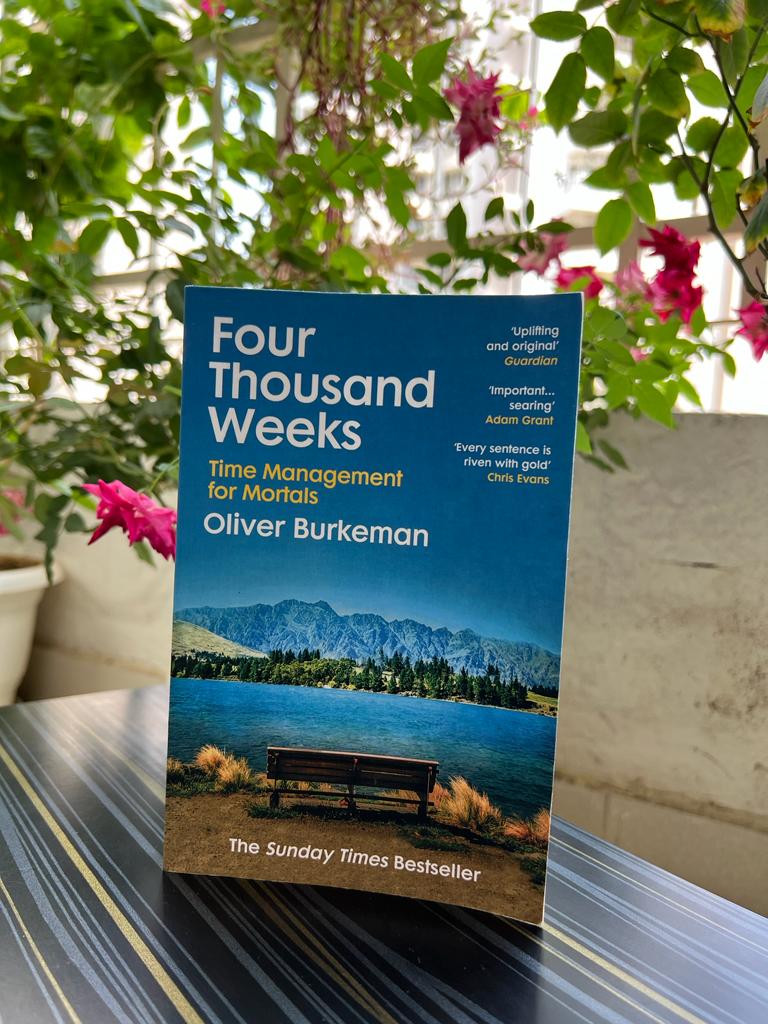
“Four Thousand Weeks” Summary Notes | Quick Reads For Busy Minds epi 18
Welcome to “Quick Reads for Busy Minds,” a blog series tailored for the vast and bustling community of individuals with limited time but an insatiable thirst for knowledge. In each article delight, we’ll unravel the essence of a thought-provoking book, distilling its key takeaways into a concise 10-minute read. Whether you’re a professional navigating a hectic schedule or someone seeking intellectual nourishment on the go, this series aims to provide you with insightful summaries that capture the heart of each book, empowering you to absorb wisdom in a fraction of the time. Episode 18 of the series presents Four Thousand Weeks Summary Notes highlighting that true fulfillment comes not from doing more, but from doing what truly matters within our beautifully finite four thousand weeks.
“Four Thousand Weeks” Summary Notes & key ideas
A Refreshing Perspective on Time
Burkeman begins with a striking truth: the average human life spans about four thousand weeks. When we confront this number honestly, it shifts how we look at everything else. Most of us live with an underlying belief that if we just try harder, plan better, or optimize more, we’ll somehow “get it all done.” But in reality, no system or planner can conquer the infinite stream of tasks, desires, and distractions life throws at us. By accepting the finiteness of time, we’re not giving up control, we’re finally seeing life clearly. And when we stop trying to do everything, we can finally focus on what matters most. Burkeman invites us to embrace our limitations, not as weaknesses but as guideposts.
Rethinking Productivity and Control
One of the book’s most powerful ideas is that productivity, as it’s often sold to us, is a trap. The more we try to “get ahead,” the faster new tasks and obligations appear. We end up on an endless treadmill of optimization, constantly chasing a future moment when everything will finally feel under control. But that moment never really comes. Burkeman argues that instead of trying to control time, we should focus on living within its natural boundaries. It’s about understanding that our energy and attention are finite, and the real power lies in choosing wisely how to spend them. This means saying no more often, even to good opportunities, because every “yes” is also a “no” to something else.
The Beauty of Choosing What Matters
Instead of endlessly postponing meaningful experiences for “someday,” we begin to prioritize them today. The fear of missing out slowly transforms into the joy of missing out. Burkeman also encourages us to stop treating the present as a stepping stone to some future ideal. Rushing through the moment in the hope of reaching a better version of life only makes us more disconnected. True richness lies in slowing down, savoring the ordinary, and being fully present. When we stop resisting time and start flowing with it, everyday moments like a shared conversation, a walk in the sun, or a quiet cup of tea, gain extraordinary depth.
Embracing Mortality as Motivation
Perhaps the most profound part of Burkeman’s message is his invitation to face our mortality, not with fear but with clarity. Knowing that our weeks are limited doesn’t diminish life, it enriches it. It pushes us to stop wasting energy on trivial things and directs us toward what really matters: meaningful work, nurturing relationships, and personal growth. This honest confrontation with our finite existence acts as a compass, guiding our choices and helping us live with intention rather than distraction.
Final takeaway | “Four Thousand Weeks” Summary Notes
Instead of offering another productivity hack, this book challenges the very obsession with efficiency that defines modern life. This book isn’t a manual on how to do more. It’s a gentle wake-up call to stop treating time as a problem to solve and start seeing it as a gift to be experienced. By embracing our limits, accepting imperfection, and choosing presence over constant striving, we can lead richer, more meaningful lives. “Four Thousand Weeks” Summary Notes doesn’t offer shortcuts or miracle strategies but something far more powerful: perspective. May this reminder help you choose presence over perfection, depth over distraction, and intention over endless busyness. After all, how we spend our weeks is how we spend our lives.
Get the book here : Four thousand weeks by oliver burkeman https://amzn.to/4ogQDKL
Read also : “Stolen Focus” Summary Notes | Quick Reads For Busy Minds epi 17 https://thebrightdelights.com/stolen-focus-summary-notes-quick-reads-for-busy-minds-epi-16/