How much stress is good ?
Ever wondered how much stress is good ?Sit back and relax, because this article delight is going to take you all through the good and bad stress.
When Stress Is Actually Good for You
It’s true that stress can be a health risk, and that we’re often encouraged to avoid it , if we want to live happy, productive and long lives. But research suggests that some stress can actually be beneficial to performance.
Have you ever noticed that you perform better when you are just a little bit nervous? For example, you might do better at an athletic event if you are excited about participating or do better on an exam if you are somewhat anxious about your score.
In psychology, this relationship between arousal levels and performance is known as the Yerkes-Dodson Law ( https://en.wikipedia.org/wiki/YerkesDodson_law )
What impact can this have on our behavior and performance?
The Yerkes-Dodson Law and Performance
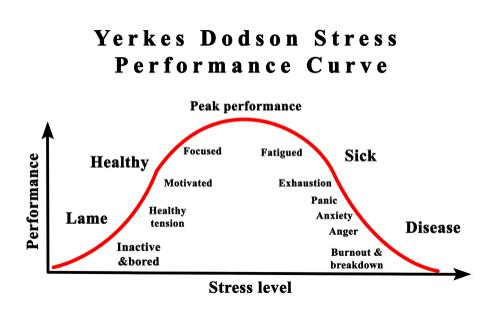
The Yerkes-Dodson law is a model of the relationship between stress and task performance.
It proposes that you reach your peak level of performance with an intermediate level of stress, or arousal. Too little or too much arousal results in poorer performance.
This is also known as the inverted-U model of arousal.
Yerkes-Dodson curve

The left side of the curve represents low stress. The right side represents high stress. And at the center is a medium level of stress.
The vertical line on the left side goes from poor performance (at the bottom) to peak performance (at the top).
The optimal state of stress and optimal performance come together in the middle of the curve.
Yerkes and Dodson formed their theory while performing experiments on mice. Using mild electric shocks, they were able to teach the mice to learn a task, which they called a “habit,” more quickly.
But as the shocks got stronger, the mice took longer to learn the task, maybe because they were more focused on avoiding the shock than on completing the task.
Yerkes and Dodson hypothesized that as arousal increases, the ability to form a habit or perform a task well also increases. It gives you sufficient motivation.
But that works only up to a certain point, known as the optimal level. As stress surpasses that point, your performance begins to deteriorate. You’re too stressed and anxious to do your best.
Good & Optimum Stress
A moderate level of stress goes a long way. It’s manageable, motivational, and performance enhancing. Your heart beats a bit faster. You feel a sense of clarity and alertness. Your brain and body are all fired up.
It’s that little extra push you need when a hard deadline looms and you’re up for a promotion. It’s the rush you get before the black belt test you’ve been working toward for so long.
There’s something you want. You’ve definitely got skin in the game. And a moderate surge of stress is boosting your performance.
Final Takeaways
Basically, you need just enough stress to provide motivation but not so much that you’re overwhelmed. That’s difficult to pinpoint and will differ from person to person.
A mild to moderate amount of short-term stress can result in an acute response that provides the motivation and energy you need, just when you need it. It lasts only long enough to help you perform your best. Too little stress doesn’t provide much in the way of motivation. Too much stress causes a stronger reaction that can hamper performance. So try to maintain your optimal level of stress that differs from person to person, according to factors like the specific task, degree of skill, and confidence level.
Read more : Delayed Gratification & The Marshmallow Experiment ( https://thebrightdelights.com/delayed-gratification-the-marshmallow-experiment/ )
Books that help :
- Easy Guide to Stress Relief ( https://amzn.to/3yR8qjp )
- Buddha on Happiness (https://amzn.to/3stPOEM)
- The Little Book of Mindfulness ( https://amzn.to/32opgtX )
- Yoga & Stress Management (https://amzn.to/33M4Dbv)
- Easy Guide to Stress Relief (https://amzn.to/3yTyTNd)