The Johari Window | Explore Hidden Facets of Your Personality
Understanding what others think about us can be like solving a puzzle, especially if we’re not Professor X with mind-reading abilities. Often, our perceptions can be a bit off, not because we’re clueless about others, but because we might not fully grasp ourselves. This creates a gap between how we see ourselves and how others see us, and spotting this gap can be tricky. So step in to the world of the Johari Window – a handy tool for self-awareness. You can imagine it as a window with different panes, each revealing a unique aspect of who you are. This window lets you see what’s known to yourself and others, but also what might be a mystery to both.
What is The Johari Window Model ?
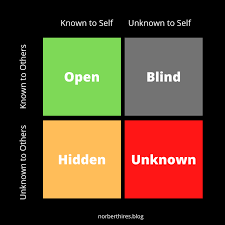
The Johari Window (or the Jo Harry Window) was developed by Joseph Luft and Harry Ingham in 1955. As you may have just realized, the name of the model is derived from a combination of their first names! The window consists of four quadrants or planes to represent different aspects of a person’s knowledge about themselves and how others perceive them. These quadrants are: Arena, Blind Spot , Mask, and Unconscious.
The Open Area or Arena (known by yourself, and know by others too)
The Blind Spot (unknow by yourself, but known by others)
The Hidden Area or Mask (known by yourself, but unknown by others)
The Unknown or Unconscious (unknown by yourself, and unknown by others too)
Lets understand these pans in details.
The Four Quadrants of the Johari Window

Arena or Open Area
The first quadrant, known as the “Open” or “Arena,” contains aspects of a person’s personality, behaviors, and feelings that are known to both themselves and others. These are the areas of open communication and shared understanding, which form the basis for healthy relationships and effective collaboration.
Blind self or blind spot
Information about yourselves that others know in a group but you will be unaware of it. Others may interpret yourselves differently than you expect. In all of your relationships, people notice things about your blind area that you probably do not know about yourself. You can use this to figure out what others think about you, and being open to that feedback can help you grow
Hidden area or façade
Information that is known to you but will be kept unknown from others. This can be any personal information which you feel reluctant to reveal. This quadrant highlights the importance of selective self-disclosure and privacy in relationships. Blind spot encompasses all aspects of yourself that are known to the you but you kept it hidden from others.
Unknown or Unconscious
This quadrant contains elements about you that neither you nor others are aware of yet. These can be latent talents, undiscovered potentials, or deep-seated unconscious biases. The Unknown quadrant encourages exploration and self-discovery over time. The key to this is that new experiences teach us things about ourselves and others that would not have been known otherwise. Breaking into the Unknown area pane of the Johari Window model helps us get out of our comfort zone and understand the world a bit better.
Key Benefits of Understanding The Johari Window
Strengthened Relationships
By expanding the “Open” quadrant, we build stronger connections with others. This mutual understanding forms the basis of healthy and harmonious relationships.
Reduced Blind Spots
The Johari Window helps identify aspects of ourselves that may be blind spots, things that others see but we are unaware of. This awareness allows for personal development and self-improvement
Improved Communication Skills
The model encourages open and honest communication. As we can share more about themselves, it fosters trust and creates a foundation for effective communication with others.
Empathy and Understanding
The model encourages us to consider the perspectives and perceptions of others. This fosters empathy and a deeper understanding of different viewpoints.
Conflict Prevention
By proactively addressing potential blind spots and hidden facets, we can prevent misunderstandings and conflicts from arising in the first place.
Final Takeaway
The Johari Window provides a clear framework for delving into both your conscious and unconscious biases. This exploration not only enhances your self-awareness but also deepens your insight into others. Beyond that, it serves as a valuable tool for personal growth and fostering stronger workplace connections.Embracing the Johari Window empowers us to not only uncover our blind spots but also to appreciate the unique complexities that shape our interactions with the world.
let’s open this window together !https://absel-ojs-ttu.tdl.org/absel/article/view/2298/2267
Read also : Box Breathing: The Ultimate Stress-Relief Technique
https://thebrightdelights.com/box-breathing-the-ultimate-stress-relief-technique/
Further studies : https://absel-ojs-ttu.tdl.org/absel/article/view/2298/2267