Do The Stroop Effect Experiment Yourself | How Our Brain Processes Information !
Stroop Effect discovered by Ridley Stroop in the 1930s refers to the difficulty experienced when attempting to name the color of a word’s font when the word itself is a different color. This effect has been helpful to understand the human brain better. So let’s Do The Stroop Effect Experiment Yourself here and get to know How Our Brain Processes Information to an extent.
What Is The Stroop Effect ?
The Stroop effect is a phenomenon that occurs when the name of a color doesn’t match the color in which it’s printed . For instance, the word “blue” appears in red text rather than blue. In such a color test ,aka a Stroop test , you’d likely take longer to name the color or be more likely to get it wrong than if the color of the ink matched the word.
Do The Stroop Effect Experiment Yourself !
Do your own stroop test here.
The easy practice test:
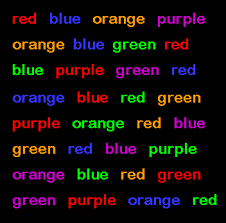
Name the colour and start the timer from naming Red to Purple.

The real hard test:
Do the same with the following series. Pay attention : Name the COLOR and not what the word says.

To practice the test easily without any timer, visit https://itservices.cas.unt.edu/~tam/SelfTests/StroopEffects.html
Do you notice it takes much longer time to complete the second test than the first test? The reason why it takes longer is because the brain has to suppress the wrong answer that interferes with the right answer, before the right answer comes through.
Congruent and Incongruent condition of The Stroop Test
Naming the colour of the ink is rather easy in trials where the word and colour are the same. These conditions are called the congruent conditions, because the colour and the written information match. Incongruent conditions, on the other hand, are more difficult, because then the colour of the ink and the word do not match. For example, the word ‘red’ printed in green. Typically, because of the conflicting information, people are slower to name the colour of an incongruent items than of congruent items. The difference in reaction time between incongruent and congruent items is known as the within-language Stroop effect.
How the Stroop Effect Works | Stoop Effect Explained
What this reveals is that the brain can’t help but read. It’s easier to say the color of a word if it matches the semantic meaning of the word. The task demonstrates the effect that interference can have when it comes to reaction time.
It may seem as though the Stroop effect is just a fascinating experiment with no real effect on human psychology. In truth, it illustrates a lot about the way we process information. And helps us assess our ability to override our instinctual fast thinking. A study published in the Psychological Review stated, “The effects observed in the Stroop task provide a clear illustration of people’s capacity for selective attention and the ability of some stimuli to escape attentional control.” One of the explanations for the difficulty is that we are so used to processing word meaning while ignoring the physical features of words, that it is a learned response. The Stroop task requires us to do something which we have never learned and which is opposite what we normally do.
Final Takeaway
Stroop Effect in real life is encountered with advertisements depending on the color and font used. This is especially so with the Emotional Stroop Effect. Using words with an emotional valence delays processing when catching only glimpses of advertisements while traveling or using social media. The Stroop Test has been found to be very useful in the psychological evaluation of cognitive deficits in individuals with mental health issues. However multiple studies, including the original experiments by Stroop, suggest that practice can decrease Stroop inference. This has implications for our learning skills, ability to multitask, and how we form habits.
Read also : Freudian Slips | What They Reveal About You ? https://thebrightdelights.com/freudian-slips-what-they-reveal-about-you/